Rita Chaos (Terrassa, 2001) takes historical abandonment as the original driving force behind her collage compositions. She defines herself as a romantic manipulator of vintage photographic aesthetics.
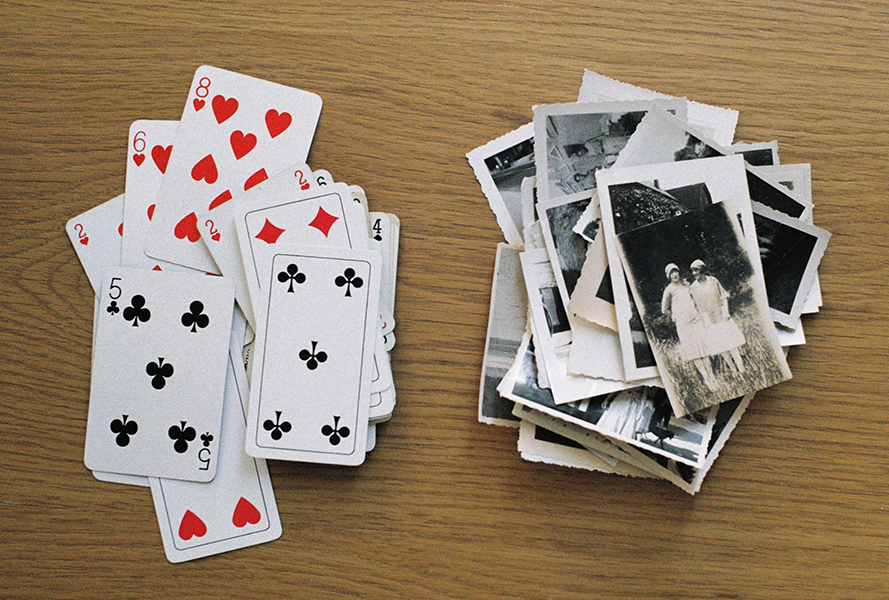
Poker cards and abandoned images come into play through the technique of collage, creating a game board where mischief is welcome. She has no problem admitting that she does not know how to play cards and, perhaps, that very lack of knowledge is precisely why she feels so free when holding them in her hands: she plays and replays them until she finds a composition among the materials that attracts her.
She abandons pre-established rules, which she has never known, and designs her own game board. Ironic composition, mischievous composition: her checkmate.
What I like about the past is the mystery I will always have simply because I did not live through it. This mystery is the driving force behind my interest. Who are they? What might they be doing? Did they get along?
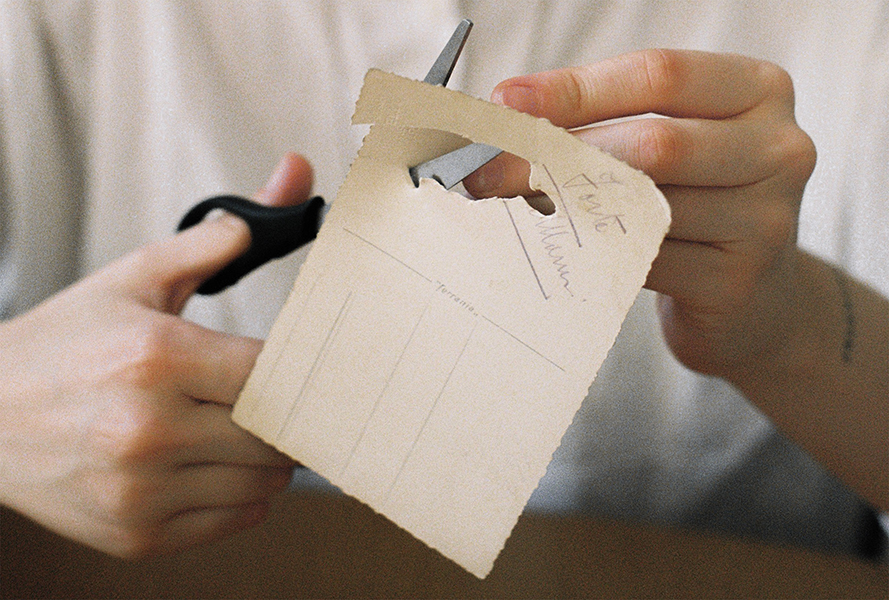
I could leave the images alone and accept that the stillness they present translates into a truthful stillness. There is no need to look at them more intensely, thinking that they might tell me their story. I have compensated for this stillness and silence with my imagination, transferred into my hands. Since I am a nervous and impatient person, having scissors in my hands is always a danger. Since I cannot draw or paint, cutting became that gesture that compensates for the movement and the voice that I have not managed to find in the photographic historical past.
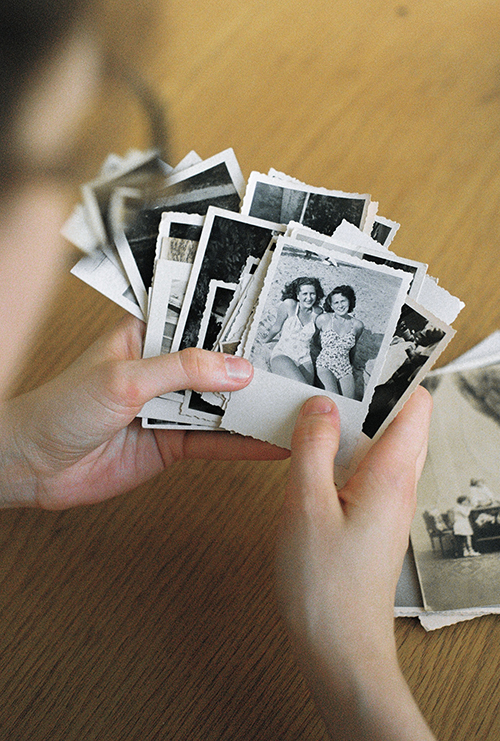
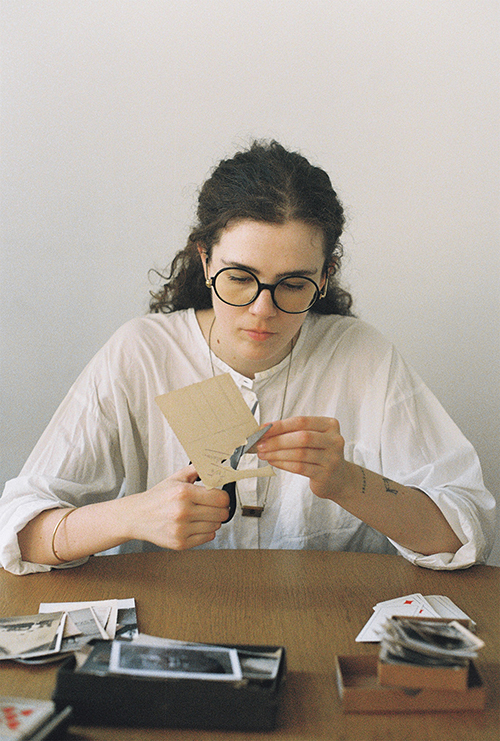
But here I am, at my desk, with an image, looking at it from just a few millimetres away. As if I wanted to smell it visually. I look at it, look at it again, then leave it aside. I pick up another one, same ritual. I play with the tips of my fingers, tracing the contours of its rough little frame. I leave it, pick up the other one again. What are you trying to tell me, little one? Or what am I trying to tell you, past?
And suddenly, I see that the handles of the scissors already have fingers tickling them: the dance of the image begins. It is a sequence of movements measured in tiny fractions of a centimetre, trying to make the scissors follow the historical line. Right, left, a little to the right, a little more, left. Done. I now have the cut-out I wanted. I place it in the palm of my hand as if I wanted to offer it a home after aggressively dethroning it from its history. Does it still belong to its time, or is it now part of my creative present?
I find the images I work with in dusty boxes at antique and second-hand markets. I found the first playing cards abandoned in a drawer at my parents’ house. They were dusty too. The first time I combined a cut-out with a card, I did not really know what it meant. I still do not know, and I like this micro-rebellion.
Both materials—the card and the cut-out—are historical materials that had meaning in the past and that, now, hands from the present play with. The idea of play arises naturally, and the cards emphasise this idea. A new deck is created, and the audience is free to play with it in their own way. But why have you put this card together with this piece of paper? What does it mean? Why are there two clubs if there are three people in the cut-out? Dear person, I do not know.
Defending my work as a purely aesthetic game is not always easy. It may seem empty of content, but to me, it is full of irony.
2026 — Historical Tickles. Exhibition as part of the Revela’t Festival programme. Vilassar de Dalt, Maresme (Barcelona).
2026 — MIA Photo Fair BNP Paribas, Contemporary Photography Fair, Milan. Villa Alegre Gallery (Barcelona).
2025 — 54 Jokers. Solo exhibition at Centre Cultural La Casa Elizalde, as part of the 39/11 Novembre Fotogràfic festival programme (Barcelona).
2024 — 54 Jokers. Solo exhibition at Sala 3, Sala Muncunill, Terrassa.